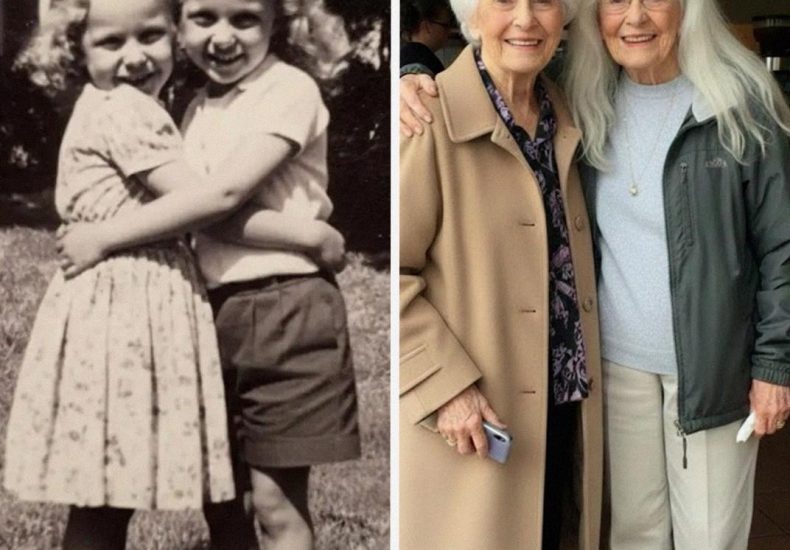
The Sister I Lost, the Sister I Found
I was five years old when my twin sister, Ella, disappeared.
That sentence has followed me my entire life, like a quiet echo I never quite learned to silence.
That day started like any other. My parents were at work, and Ella and I were staying with our grandmother. She lived near the edge of a forest, the kind that feels peaceful until you imagine a child wandering into it alone.
I remember feeling sick that morning. Feverish. Weak. My grandmother tucked me into bed and sat beside me, cooling my forehead with a damp cloth until I finally fell asleep.
Ella didn’t like sitting still. She never did. While I slept, she went outside to play with her favorite red ball.
When my grandmother stepped out later to call her back in, there was no answer.
Just silence.
The search started almost immediately. Neighbors. Police. Volunteers combing through the woods. I remember adults whispering, voices low and urgent, faces tight with fear.
They found only one thing.
Ella’s ball.
Months passed. And then, one evening, the police came to our house. I don’t remember their faces clearly, only the way my mother collapsed into a chair when they spoke.
They told my parents that Ella had been found dead.
I was too young to understand what death really meant, but I knew what loss felt like. Even at five, Ella was my whole world. We shared toys, secrets, clothes stolen from our mother’s closet. We never fought. Not once. People always commented on how inseparable we were.
After that day, the house felt wrong. Too quiet. Too empty.
I kept asking questions.
Where did they find her?
What happened to her?
Why didn’t she come back?
My mother would stiffen every time. Eventually, she snapped—her voice cracking, eyes red.
“You don’t need to know,” she said. “Asking hurts me. Please stop.”
So I did.
There was no funeral that I remember. No grave we visited. Or maybe there was, and my mind buried it somewhere deep because it couldn’t handle the truth.
Years passed. Then decades.
I grew up. I married. I had children. I built a life that, from the outside, looked full and happy.
But Ella never left me.
Sometimes I’d catch myself reaching for a second cup at the table. Sometimes I’d dream of her—always just out of reach, always smiling, never speaking.
Now I’m 73 years old.
Recently, my granddaughter was accepted into a college in another state. I was so proud I cried when she told me. I decided to fly out and visit her for a few days, help her settle in, pretend I wasn’t terrified of how fast time moves.
One morning, while she was in class, I decided to go for a walk.
I wandered into a small café near campus. Cozy. Warm. The kind of place where everyone knows each other’s order. I stood in line, scrolling through my phone, half-listening to the hum of conversation.
Then I heard a voice.
It sounded exactly like mine.
Same tone. Same rhythm. Even the slight rasp I’ve had since my forties.
I looked up.
A woman was standing at the counter, picking up her coffee to go. She turned around—and my blood ran cold.
She looked exactly like me.
Same face. Same eyes. Same age lines. Same posture.
It felt like the floor shifted beneath me. Like I was staring into a mirror that shouldn’t exist.
I honestly thought I might faint.
Before I could talk myself out of it, I tapped her gently on the shoulder.
She turned around—and froze.
Her eyes widened. Her mouth fell open. She stared at me the way I must have been staring at her.
My voice came out shaky, barely more than a whisper.
“Oh my God… Ella?”
She gasped.
“How do you know that name?” she asked.
We sat down at a small table in the corner. Two identical women, trembling hands wrapped around cooling cups of coffee.
Her name wasn’t Ella anymore.
It was Eleanor.
She told me everything.
When we were five, a woman had taken her from the forest. A woman who couldn’t have children of her own. She said she’d found Ella wandering alone, crying. Instead of calling the police, she took her home.
By the time authorities realized Ella was missing, the woman had already moved across state lines. When Ella fell ill months later and was hospitalized under a false name, there was confusion. A misidentification. A tragic mistake.
The police believed the wrong child had died.
My sister grew up believing she was abandoned. That her parents didn’t want her. That no one came looking.
And I grew up believing my twin was dead.
When our parents passed away years ago, all the secrets went with them.
Or so we thought.
DNA tests confirmed what our hearts already knew.
We were twins.
That afternoon, we walked side by side through the park, laughing and crying like children who’d finally found their way back home.
We didn’t get our childhood back.
But we got something else.
Time.
And now, every morning, when I hear a voice just like mine across the room, I smile.
Because after sixty-eight years, I’m no longer half of a story.
I’m whole again.
Leave a Reply