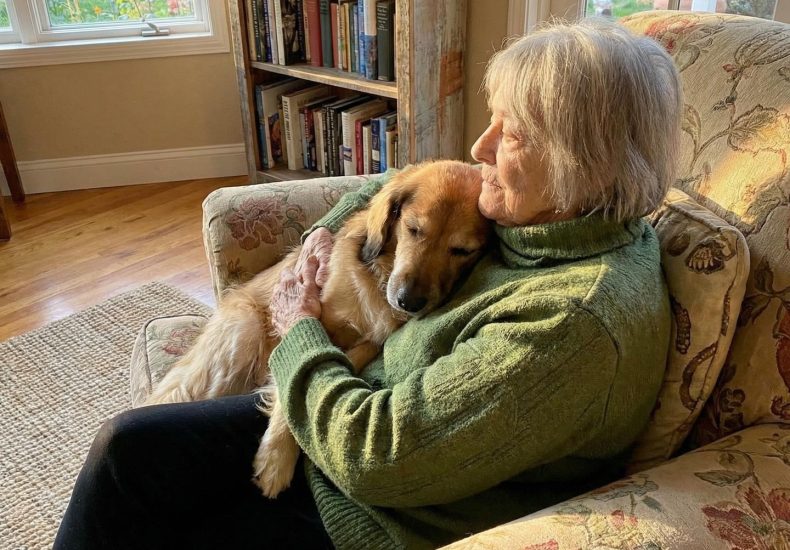
My Family Fought Over Grandma’s Inheritance — I Took Her Dog and Found the Secret She Meant Only One of Us to See
When my grandmother died, our family fell apart faster than I ever thought possible.
One moment, we were standing together in black coats, trading stories about her stubborn streak and her soft heart. The next, everyone was arguing over who deserved what—over a will that, to everyone’s shock, didn’t exist.
Grandma Margaret had always insisted she’d “taken care of everything.” She was meticulous to a fault. Her spice jars were labeled in careful handwriting. She kept receipts from decades ago tucked into neat envelopes. So when the lawyer admitted he couldn’t find an updated will, the room went quiet in the worst way.
Within days, her house became a battleground.
Aunts, uncles, cousins—all of them descended on that old place like grief had flipped a switch and turned into hunger. It wasn’t just about money. It was about antiques, jewelry, photographs, furniture—objects loaded with memory and meaning, suddenly treated like prizes.
I didn’t go there to claim anything.
I went because of Daisy.
She was Grandma’s dog—a small, scruffy terrier mix with cloudy eyes and a graying muzzle. Twelve years old. Half-blind. Gentle in a way that made you instinctively lower your voice around her. Daisy had been Grandma’s shadow for as long as I could remember, padding after her from room to room, curling up at her feet every night.
When I arrived that morning, Daisy was lying beside Grandma’s favorite armchair, trembling slightly, as if she couldn’t understand why her world had gone so quiet.
My Aunt Lydia glanced down at her and wrinkled her nose.
“Someone needs to take that dog,” she said. “I can’t have hair all over my clothes.”
“I’ll take her,” I said without thinking.
My cousin Lucas barely looked up from a drawer he was rummaging through. “You sure? She’s old. Probably won’t be around much longer.”
“I’m sure,” I replied.
No one argued. They were too busy tearing through cabinets and boxes, hoping to find something that proved Grandma had promised them more.
I knelt down, stroked Daisy’s soft fur, and whispered, “Come on, sweetheart. Let’s go home.”
As I carried her out, I heard drawers slamming and voices rising behind me. Grandma hadn’t even been gone a week, and already her kindness was being buried under greed.
Back at my apartment, Daisy wandered aimlessly, sniffing corners and letting out little whimpers. I set up her bed near the window, filled her bowl with water, and sat beside her on the floor.
For the first few days, she barely ate.
I understood. Neither did I.
I’d been close to Grandma—closer than most of the family. Every Sunday, I visited for tea. She’d talk about “the old days,” about my grandfather, who’d died before I was born, about mistakes she’d made and things she’d learned too late. There was always a quiet sparkle in her eyes, like she knew something the rest of us didn’t.
Once, she’d told me, “The things that matter most, Lucy, aren’t always in plain sight. You just have to know where to look.”
I thought she was being poetic.
I didn’t realize she meant it quite so literally.
About a week after the funeral, the family fighting reached a new level. Aunt Lydia insisted Grandma had promised her the house. Uncle Peter swore the jewelry collection was his. My mother tried to calm everyone down, but it was useless.
I stayed out of it.
I had Daisy.
One evening, while brushing her fur, I noticed she kept pawing at her collar. It was old—faded red fabric, the brass tag dulled with age. I figured it was bothering her and decided to replace it.
When I unbuckled it, I heard a soft rattle.
That stopped me.
I turned the collar over in my hands. The tag was heavier than it should have been, and along one edge was a seam so fine it was almost invisible. My heart began to race. I grabbed a small screwdriver from my desk and carefully pried it open.
Inside was a folded slip of paper.
My hands shook as I unfolded it.
The handwriting was unmistakable—neat, looping cursive I’d seen on birthday cards and recipe notes my whole life.
It read:
“To whoever truly loved me, look beneath the oak.”
That was it.
No signature. No explanation.
I sat there for a long moment, staring at the words. “Whoever truly loved me” felt intentional. Selective.
I looked at Daisy, who was watching me quietly, her tail giving a small, hopeful wag.
“What did you help her hide, huh?” I whispered.
The next morning, I drove back to Grandma’s house.
The family was still there, sorting through her belongings like prospectors convinced treasure was just one drawer away.
“What are you doing here?” Aunt Lydia asked sharply.
“I came to pick up a few personal things Grandma left me,” I said.
She eyed me, suspicious but distracted, and waved me off.
I slipped out back.
The oak tree stood in the far corner of the yard—massive, solid, unchanged. Grandma used to sit beneath it on summer afternoons, lemonade in hand, while Daisy chased butterflies around the roots.
I walked around the trunk, scanning the ground. Nothing obvious. Just leaves, dirt, and grass.
Then I remembered something.
When I was little, Grandma used to warn me not to trip near the tree. There was a stone there, she said—“loose, but important.”
I dropped to my knees and brushed away the leaves.
There it was.
A flat stone, slightly darker than the others.
My breath caught as I pried it up.
Beneath it was a small, weatherproof metal box.
Inside were documents. A handwritten letter. And a sealed envelope with my name on it.
Grandma hadn’t forgotten to make a will.
She’d simply made sure it went to the only person who wasn’t looking for it.
And as Daisy pressed against my leg, I realized the truth:
She hadn’t left her legacy to those who wanted her things.
She’d left it to the one who stayed for her heart.
Leave a Reply