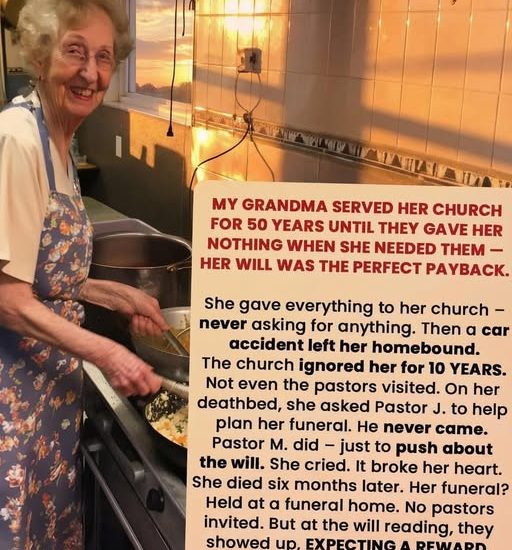
My Grandma Served Her Church for 50 Years — When She Needed Them, They Gave Her Nothing. Her Will Was the Perfect Payback.
My grandmother devoted her life to her church.
For fifty years, she was there every Sunday. Every fundraiser. Every potluck. Every bake sale. She cleaned floors, cooked meals, organized donations, and quietly slipped money into the offering plate—even when she didn’t have much herself.
She never asked for recognition. Never wanted praise.
She believed service was the reward.
Then, one winter evening, everything changed.
She was driving home from choir practice when another car ran a red light and slammed into her. The accident didn’t kill her—but it took something just as important.
Her independence.
She became homebound almost overnight.
At first, she waited patiently. Surely the church would come check on her. A visit. A phone call. A prayer.
Days passed. Then weeks.
No one came.
Months turned into years.
For ten years, the church she had served faithfully ignored her existence. Not one pastor visited. Not one deacon stopped by. No casserole appeared at her door. No card. No call.
Nothing.
As her health declined, my grandmother still spoke kindly of them. She made excuses for their absence.
“They’re busy,” she’d say softly. “God understands.”
But I saw the pain she hid behind her smile.
On her deathbed, knowing time was short, she asked one final thing.
She asked Pastor J. to help plan her funeral.
He promised he would come.
He never did.
Then she asked Pastor M.
He did visit—but only to ask about her will.
That was the moment she finally broke.
She cried quietly after he left, clutching my hand.
“It’s not about the money,” she whispered. “I just wanted someone to care.”
She passed away six months later.
Her funeral was held at a small funeral home.
No pastors attended. No church representatives were invited.
But a week later, when word spread that her will would be read, something unexpected happened.
They showed up.
The Day the Truth Was Read Aloud
The conference room at the lawyer’s office was packed.
Pastor J sat in the front row, hands folded confidently. Pastor M leaned back in his chair, whispering to another church elder. They all looked… expectant.
They believed fifty years of loyalty came with a reward.
The lawyer cleared his throat.
“My client left a letter to be read before the distribution of her estate,” he said.
The room grew quiet.
He unfolded the paper and began to read.
“To the church I loved,
I gave you my time, my strength, and my faith for fifty years. I believed we were family.
When I became homebound and could no longer give, you stopped seeing me.
For ten years, I waited. For a call. A visit. A prayer.
I received none.”
A murmur rippled through the room.
Pastor J shifted in his seat.
The lawyer continued.
“I asked for help planning my funeral. I was promised compassion.
Instead, I was asked about my will.
That told me everything I needed to know.”
The room was silent now.
Faces had gone pale.
The Will That Changed Everything
The lawyer adjusted his glasses.
“To the church,” he read, “I leave exactly what I was given in my final years.”
He paused.
“Nothing.”
Gasps filled the room.
The pastors stared at one another, stunned.
The lawyer continued reading.
“All remaining funds, property, and savings are to be distributed as follows—”
She had donated everything.
Not to the church.
But to organizations that had shown her kindness when the church had not.
A local meals-on-wheels program.
A volunteer driver service that took her to doctor’s appointments.
A small animal shelter she loved watching online.
And the remainder was placed into a trust to help elderly individuals who were isolated and forgotten—specifically those abandoned by institutions meant to care for them.
The final line of the letter was read aloud.
“Faith without love is empty.
May this gift serve as a reminder that kindness should never be conditional.”
Aftermath
The pastors left quietly.
No speeches. No objections. No arguments.
They had nothing to say.
In the weeks that followed, word spread through the community. Congregation members began asking questions. Some left the church. Others demanded accountability.
My grandmother’s story became a lesson whispered in hallways and discussed at kitchen tables.
As for me, I keep her photo on my shelf.
Not because of what she left behind.
But because of how gracefully she stood up for herself—without bitterness, without anger.
Just truth.
She served faithfully for fifty years.
And in the end, she reminded everyone what faith was actually supposed to look like.
Leave a Reply