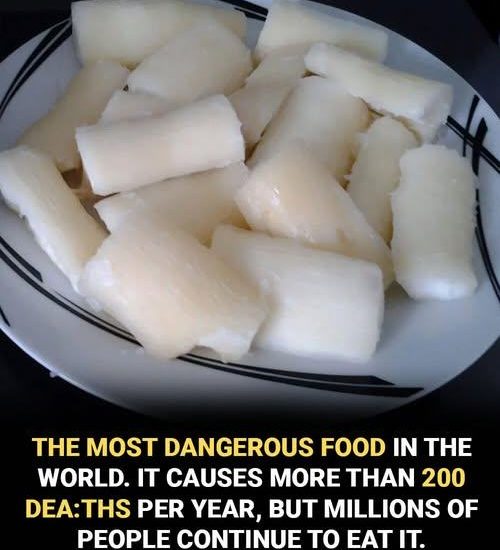
Harmful if Made Wrong: The Hidden Risk Behind a Globally Popular Food
Across many countries—especially in Africa, Asia, and parts of South America—cassava is more than just food. It is survival. It’s turned into bread, flour, fufu, tapioca, garri, and countless traditional dishes. But behind this incredibly common ingredient lies a little-known danger: cassava can be harmful, even deadly, if not prepared correctly.
Yet millions continue to eat it every single day.
Why?
Because for most people, the danger is not obvious.
The Comforting Food with a Secret
Cassava (also known as manioc or yuca) looks harmless—simple, starchy, and easy to cook. But what many don’t realize is that raw cassava naturally contains cyanogenic glycosides, compounds that can release cyanide when improperly processed.
Not enough to be detected by the senses.
Not enough to taste bitter or smell unusual.
But enough to harm.
In places where cassava is a staple, the risk is well understood—passed down through generations. People know how to soak it, ferment it, grate it, boil it, or roast it in ways that neutralize its natural toxins.
But when cassava is handled carelessly or cooked incorrectly, the consequences can be tragic.
A Hidden Risk With Real Consequences
Every year, global health reports note hundreds of cases of severe illness—and even death—linked to poorly processed cassava. That number can sometimes rise in areas facing food shortages, drought, or poverty, where people rush the preparation or skip essential steps.
Children are especially vulnerable.
So are communities unfamiliar with traditional methods.
What makes cassava dangerous isn’t a poison added to it—it’s the toxin already inside, waiting to be neutralized. Think of it like pufferfish in Japan or certain types of wild mushrooms:
perfectly safe when handled correctly, but risky when they aren’t.
So Why Do Millions Keep Eating It?
Because when cassava is processed the right way, it is perfectly safe.
Not just safe—nutritious, filling, and incredibly important in regions where other crops fail.
People eat cassava because:
✔ It grows in poor soil
Even where corn, wheat, or rice fail, cassava thrives.
✔ It resists drought
It can survive climates too harsh for many staples.
✔ It’s versatile
Boiled, fried, baked, fermented, dried—cassava adapts to dozens of cultural dishes.
✔ It keeps communities fed
In many countries, it isn’t just a preferred food—it’s the backbone of food security.
The danger doesn’t lie in the ingredient itself, but in the knowledge gap.
Cassava is a food that must be respected, not feared.
A Tradition of Safety
In cultures that rely heavily on cassava, safe preparation is a tradition spanning centuries:
- Soaking the root for several days
- Fermenting it to break down toxins
- Drying it thoroughly
- Boiling or roasting it until fully cooked
- Discarding the cooking water
Every community has its own method, but the goal is always the same:
remove the toxins, keep the nourishment.
This traditional wisdom is so effective that billions of servings are eaten safely every year.
When Modern Convenience Meets Traditional Food
Ironically, the real risk today doesn’t come from villages or traditional cooks—it comes from people who are unfamiliar with cassava, or who assume that it can be prepared quickly like potatoes or yams.
A growing number of poisoning cases happen in:
- urban households where cassava is being tried for the first time
- kitchens where shortcuts are taken
- places where cassava flour or roots are purchased without instructions
- regions where drought forces communities to harvest prematurely
Knowledge is the key—not fear, not avoidance.
Cassava: A Food of Two Faces
What other food can be both a household staple and a hidden health risk?
Cassava is a reminder that nature gives generously—but must be handled wisely. It shows how cultural knowledge, passed from one generation to the next, can make the difference between danger and nourishment.
It represents both risk and resilience.
And despite the headlines calling it “the most dangerous food in the world,” the truth is more nuanced:
Cassava is dangerous only when respect for its preparation is lost.
A Final Thought
Millions of families around the world prepare cassava safely every single day. They transform a potentially harmful root into a source of strength and survival. They follow traditions designed not out of superstition but out of understanding—understanding that some foods require care.
Cassava is a powerful reminder that the line between risk and safety is often knowledge.
Handled properly, it feeds the world.
Handled carelessly, it can harm.
Knowing the difference makes all the difference.
Leave a Reply