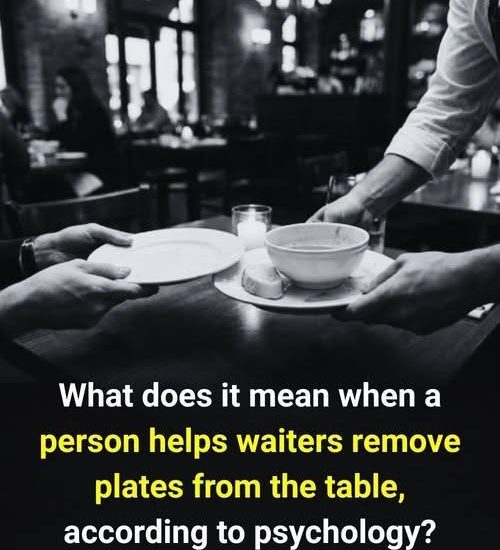
What Psychology Says About People Who Help Clear the Table
In every home, every family dinner, every gathering with friends, there’s always that one person who quietly stands up after the meal, stacks a few plates, and starts clearing the table. They might not announce it, they might not want attention—yet they do it every single time.
Is it just a habit? Good manners? Or is there something deeper going on?
Surprisingly, psychology has a lot to say about people who instinctively help after a meal. And the traits behind this simple act reveal far more than you’d expect.
1. They Possess High Levels of Empathy
People who help clean up are typically highly attuned to others’ needs.
Psychologists call this “prosocial behavior,” which is rooted in empathy—the ability to sense when others might need support and the willingness to act on it.
They notice:
- Who cooked
- Who looks tired
- Who’s overwhelmed
- Who might need a break
Clearing the table is their way of silently saying, “I see you.”
2. They Were Often Raised With Strong Social Norms
Family upbringing plays a huge role.
People who automatically help usually grew up in homes where:
- Everyone pitched in
- Chores were shared
- Helping wasn’t optional—it was expected
These early habits become part of their identity later in life.
Psychologists call this internalized prosocial conditioning—when helping becomes automatic because it aligns with one’s sense of self.
3. They Have a Cooperative Personality Type
Research on personality traits shows that people who help clean up tend to score high in:
- Agreeableness
- Conscientiousness
- Responsibility
They’re the kind of people who don’t wait to be asked. They simply do.
This cooperative mindset strengthens relationships, which is why people often gravitate toward them—they make group settings run smoothly.
4. They’re Natural Peacekeepers
Clearing the table may look like a simple action, but psychologically, it’s often tied to conflict avoidance.
These individuals tend to:
- Prevent tensions from building (“Let me help so no one argues”)
- Reduce emotional work for others
- Keep the environment calm and pleasant
They’re the glue in many social situations because they quietly reduce stress without expecting anything in return.
5. They Have High Social Awareness
Social awareness—part of emotional intelligence—means being able to read the room and respond appropriately.
People who clear the table intuitively sense:
- When the host is busy
- When the atmosphere needs a shift
- When it’s time to transition the group to the next activity
This makes them great friends, partners, and coworkers. Their minds are always one step ahead.
6. They Value Fairness and Reciprocity
Psychologically, many helpers are guided by the principle:
“If you cook, I clean.”
Or
“We all enjoyed the meal, so we all share the work.”
This fairness-driven mindset fosters healthy, balanced relationships. They dislike situations where one person carries the full load.
7. They Experience Genuine Satisfaction from Helping
Helping triggers the brain’s reward pathways—dopamine and oxytocin, the “feel-good” chemicals.
So for many people, clearing the table isn’t a chore—it’s emotionally satisfying.
It gives them:
- A sense of completion
- A feeling of contribution
- A boost of happiness
Psychologists call this the “helper’s high.”
8. They Often Make Excellent Long-Term Partners
If someone helps clear the table without being asked, they tend to have the same attitude toward:
- Household responsibilities
- Parenting
- Emotional labor
- Relationship maintenance
- Teamwork in general
These are the exact traits that make relationships thrive.
A study from the University of Michigan even found that couples who shared chores had significantly higher relationship satisfaction.
So… What Does It Really Mean?
People who naturally help clear the table are:
- Empathetic
- Responsible
- Attuned to others
- Cooperative
- Fair-minded
- Emotionally intelligent
- Habitually thoughtful
In short, they’re the kind of people who make life easier for everyone around them.
It’s never just about plates and cups.
It’s about the psychology behind thinking of others before yourself.
So the next time someone stands up after dinner and starts cleaning—
You’re not just watching good manners.
You’re watching a good heart.
Leave a Reply